AI is Coming for Conservation Organizations – and Most Are Not Ready

Edit: If you haven’t read Matt Shumer’s essay “Something Big is Happening” yet, you should do that. His brilliant essay lends urgency to this one.
AI is coming for conservation organizations, faster than anyone is prepared for.
When I decided to leave Google to work in impact innovation, I believed technology operating models eliminate enormous waste in the NGO sector from groups building things that nobody wanted, using outdated beliefs about what people needed. Looking back, I can say with confidence that approaches like Agile, UX Principles, Compute and hardware transformation have eliminated tens of millions of dollars in societal waste.
The next game-changer is arriving, and most of the conservation NGO sector still has blinders on. I’m here to tell my colleagues: Prepare for AI to do your job. I’m here to tell conservation organizations, whether NGO, government or academia around the world: AI is going to transform every organization’s ability to reach its mission. Today is the time to start preparing.
Why Conservation Jobs are Vulnerable to AI
To understand why conservation is so vulnerable, we need to look at how innovation behaves in different kinds of systems. When I look at the rate of innovation and speed of uptake in any organization or sector, the first question I ask is always: How open or closed is this system?
The answer will dictate the speed of innovation. Closed systems, such as software development organizations, have high predictability. Therefore you can make changes and measure those changes in seconds. Conservation operates in the most complex system on our planet: the natural world. Unlike software, where outcomes can be tested instantly, conservation results unfold slowly (sometimes, centuries) and often unpredictably.
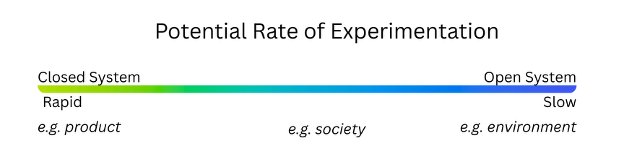
This difference explains why conservation organizations historically change and introduce innovation slowly, and also why AI will represent such a profound shock.
Conservation Careers Face Major Change
In conservation, people who have expertise in translating complexity into action have previously been prized employees. It is these roles, that traditionally required knowledge-based training, that are now ripe for disruption.
For example, The GIS certificate was a staple in my Environmental Management program. But a conservation manager who once needed weeks of GIS analysis may soon be able to ask an AI system in plain language to assemble datasets, run spatial models, and produce a decision-ready map in minutes.
Likewise, a leader who once relied on a conservation manager to develop a theory of change, set intermediate results and relevant metrics, may soon be able to query AI and incorporate the published perspectives of the best natural and social scientists in an hour rather than months.
Scientists may especially be raising their eyebrows at AI replacing what they do, but @virtrupo tweeted that “At a closed meeting at the Institute for Advanced Study (IAS), top physicists agreed AI can now do up to “90%” of their work.

If a single NGO staff member can do 10x the management and analysis “work” that they used to, 10x the number of conservation projects could move forward compared to today, with the majority of funding shifting to so-called “grey collar” jobs – for example, ground-truthing scientific model outputs, putting geolocators on animals, or clearing trails after storms blow through.
The Real Opportunity AI Creates
Like most of my acquaintances and colleagues living outside of Silicon Valley, most conservation NGO people are not constantly tracking the advances of AI. The most literate amongst them worry about prompt engineering, environmental and societal impact of the technology, and perhaps the most literate are thinking about how to use AI to build new solutions.
If this sector has the chance to 10x its impact through AI, organizations need to look seriously at how they are driving impact, and how they can create major efficiencies in how their work is done. As donors see their own sectors being revolutionized by AI, it’s only a matter of time before they will demand this of their philanthropic investments as well.
Environmental causes receive only 2% of donations made in the U.S., which in 2024 was estimated to be $11.3B. In 2025, weather and climate disasters are estimated to have caused $115B in damages. Conservation is one of the primary ways we can dampen the catastrophic impacts of these disasters, and if we’re extremely efficient with donor funds, we could be saving many more lives with the work we do.
What NGOs Must Do Now
FIRST: NGOs must invest in capabilities to unlock AI literacy. I’ve spent 15 years in innovation and the majority of funding at NGOs is going toward external solutions. In normal circumstances, it makes sense to drive mission impact this way. We are no longer in normal circumstances.
My sector (impact innovation) has been gutted – we all know that when funding dries up, “extraneous innovation” often gets cut first. Organizations are dropping their internal change capacity exactly when it is needed most to drive action in the face of today’s AI revolution.
NGOs should seriously consider dedicating some unrestricted budget to internal AI capacity development, encouraging employees to experiment with the latest AI tools, and asking employees to be part of the solution around environmental and social impacts rather than letting those concerns be a blocker to engagement.
SECOND: NGOs are also the only organizations with a deep understanding of the secondary impacts of technology. They can see how AI will soon widen the digital divide and deepen poverty and inequality, how AI is exacerbating the negative impacts of energy generation on the environment, how AI will make more people dependent on social services.
This sector is absolutely critical for being in dialogue with the builders of this technology to ensure we all working together to build AI responsibly.
A Conclusion for Conservation
Conservation has worked in long time horizons. But AI is moving fast; faster than even we who are paying attention can believe. We are at both a climate tipping point and an AI tipping point: NGOs who accept and face both are the ones who will shape how the future unfolds.
At the time of writing, I am an employee of The Nature Conservancy. Opinions expressed above are my own.
Comments